Introduction to Python and Microcontrollers
Flowing Light
Control a 10-LED bar graph to create a flowing light animation — LEDs light up one at a time from left to right, then right to left, repeating in a loop.
New Concepts
- Lists
Lists
Python lists hold a sequence of values, for example l = [1, 2, 3] is a list holding the values 1, 2, and 3. Values in a list can be access by index, so l[0] accesses the first item in the list, 1 using the example from above.
See Python documentation for more info on lists.
Component List
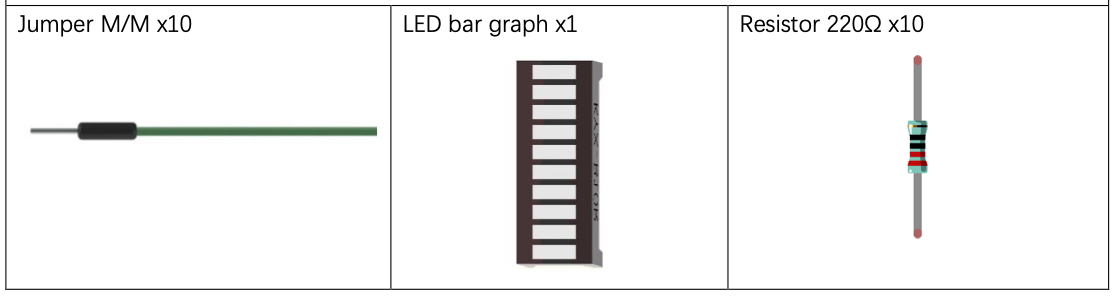
Component Knowledge
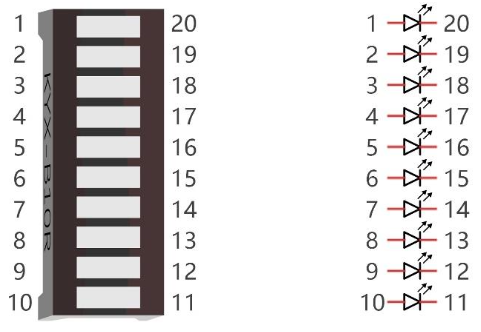
LED Bar Graph
A LED bar graph integrates 10 individual LEDs into a single compact component. Each LED has its own pair of pins at the bottom — one anode and one cathode — just like a standalone LED.
Circuit
Wiring Diagram
Disconnect all power before building the circuit. Reconnect once verified.
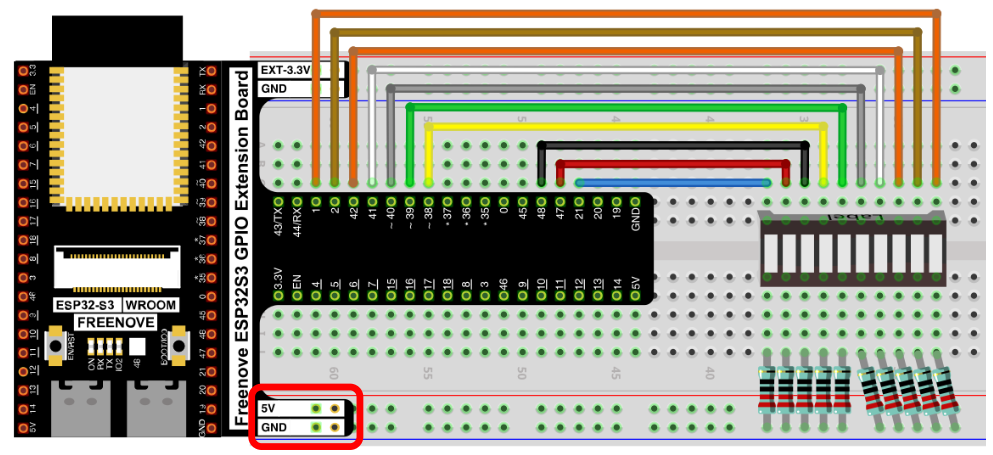
If the LED bar does not light up, try rotating it 180°. The label orientation is not standardized across all units.
Schematic Diagram
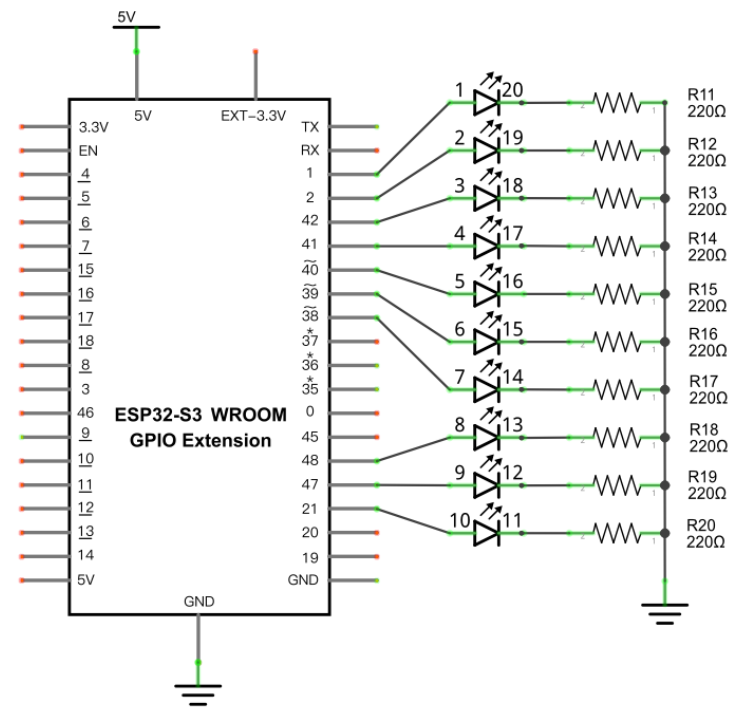
Each LED anode connects to its GPIO pin. Each cathode connects to GND through a 220Ω resistor.
Code
File: `01_first_examples/code/FlowingLight.py
import time
from machine import Pin

pins = [21, 47, 48, 38, 39, 40, 41, 42, 2, 1]

def showled():
    length = len(pins)
    # Left to right
    for i in range(0, length):
        led = Pin(pins[i], Pin.OUT)
        led.value(1)
        time.sleep_ms(100)
        led.value(0)
    # Right to left
    for i in range(0, length):
        led = Pin(pins[(length - i - 1)], Pin.OUT)
        led.value(1)
        time.sleep_ms(100)
        led.value(0)

while True:
    showled()
How to Run
Online
- Open Thonny →
01_first_examples/code/. - Double-click
FlowingLight.py. - Click Run current script — LEDs sweep left to right, then right to left.
Code Explanation
Pin list
pins = [21, 47, 48, 38, 39, 40, 41, 42, 2, 1]
Stores the 10 GPIO pin numbers in order from left to right. Using a list makes it easy to iterate over all LEDs.
Left-to-right sweep
for i in range(0, length):
    led = Pin(pins[i], Pin.OUT)
    led.value(1)
    time.sleep_ms(100)
    led.value(0)
Turns each LED on for 100ms then off, moving forward through the list.
Right-to-left sweep
for i in range(0, length):
    led = Pin(pins[(length - i - 1)], Pin.OUT)
    led.value(1)
    time.sleep_ms(100)
    led.value(0)
Iterates forward through i but accesses the list in reverse using length - i - 1.
Key Concepts
- Lists: store multiple GPIO pin numbers for easy iteration
len(list): returns the number of items in a listrange(start, end): generates a sequence of integers for theforloop- Reverse indexing:
pins[length - i - 1]accesses list items in reverse order without reversing the list itself
Reference
for i in range(start, end, step=1)
Iterates from start up to (but not including) end, incrementing by step each time.
range(0, 5)      # → 0, 1, 2, 3, 4
range(0, 10, 2)  # → 0, 2, 4, 6, 8
Adapted from Python_Tutorial.pdf Project 3.1