Introduction to Python and Microcontrollers
Soft Light
Combine ADC and PWM: read a potentiometer’s position and use it to control an LED’s brightness, so turning the knob smoothly dims or brightens the light.
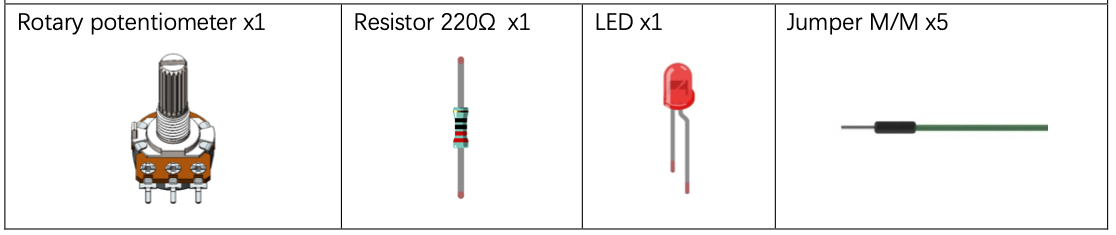
Component List
Circuit
Wiring Diagram
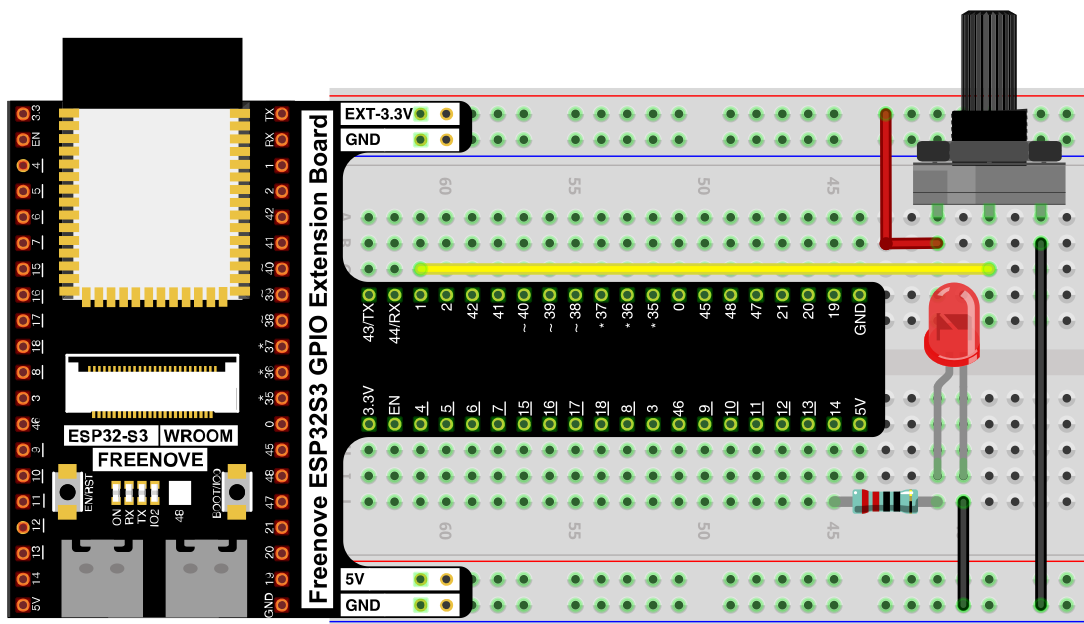
Connections:
- Potentiometer pin 1 → 3.3V, pin 2 → GND, pin 3 (wiper) → GPIO1
- LED anode → 220Ω resistor → GPIO14
- LED cathode → GND
Schematic Diagram
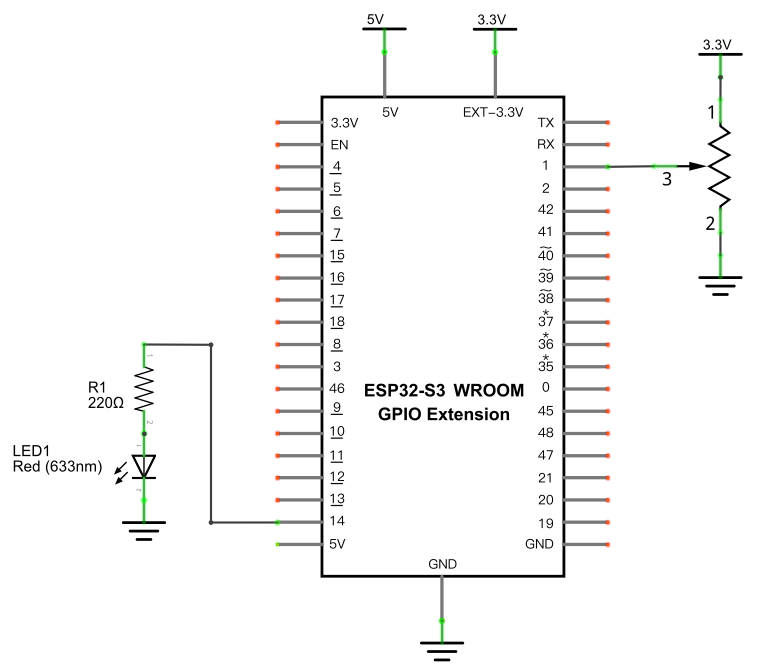
Disconnect all power before building the circuit. Reconnect once verified.
Code
File: 02_input_and_output/code/Soft_LED.py
from machine import Pin,PWM,ADC
import time

pwm =PWM(Pin(14,Pin.OUT),1000)
adc=ADC(Pin(1))
adc.atten(ADC.ATTN_11DB)
adc.width(ADC.WIDTH_12BIT)

def remap(value,oldMin,oldMax,newMin,newMax):
    return int((value)*(newMax-newMin)/(oldMax-oldMin))

try:
    while True:
        adcValue=adc.read()
        pwmValue=remap(adcValue,0,4095,0,1023)
        pwm.duty(pwmValue)
        print(adcValue,pwmValue)
        time.sleep_ms(100)
except:
    adc.deinit()
    pwm.deinit()
How to Run
Online
- Open Thonny →
02_input_and_output/code/. - Double-click
Soft_LED.py. - Click Run current script. Rotate the potentiometer’s knob — the LED’s brightness changes to match.
Code Explanation
Set up PWM output and ADC input
pwm =PWM(Pin(14,Pin.OUT),1000)
adc=ADC(Pin(1))
adc.atten(ADC.ATTN_11DB)
adc.width(ADC.WIDTH_12BIT)
PWM on GPIO14 drives the LED; the ADC on GPIO1 reads the potentiometer, same as in Read the Voltage of a Potentiometer.
Remap one range onto another
def remap(value,oldMin,oldMax,newMin,newMax):
    return int((value)*(newMax-newMin)/(oldMax-oldMin))
The ADC produces values from 0–4095, but pwm.duty() only accepts 0–1023. remap() rescales a value from one range (oldMin–oldMax) proportionally into another (newMin–newMax).
Apply the potentiometer position to LED brightness
while True:
    adcValue=adc.read()
    pwmValue=remap(adcValue,0,4095,0,1023)
    pwm.duty(pwmValue)
    print(adcValue,pwmValue)
    time.sleep_ms(100)
Reads the raw ADC value, remaps it from the ADC’s 0–4095 range into PWM’s 0–1023 range, and writes it straight to the LED’s duty cycle.
Key Concepts
- Range remapping:
remap()is a general-purpose pattern for converting any value from one numeric scale to another — useful whenever an input range doesn’t match an output range - ADC → PWM pipeline: reading a sensor and feeding its (rescaled) value directly into an output is the basic shape of most analog control projects
See Class ADC and Class PWM(pin, freq) for the full API reference.
Further Exploration
- Write a generic
remap()-based brightness curve that feels more linear to the eye (human brightness perception isn’t linear). - Replace the LED with a buzzer’s
freq()to make a “Theremin”-style pitch control.
Adapted from Python_Tutorial.pdf Project 10.1