Introduction to Python and Microcontrollers
Ultrasonic Ranging
Measure distance to an object using an HC-SR04 ultrasonic sensor, by manually timing how long a sound pulse takes to bounce back.
New Concepts
- Ultrasonic distance sensing
- Precise pulse timing with
time.ticks_us()
Ultrasonic sensor - HC-SR04
The HC-SR04 integrates both an ultrasonic transmitter and receiver. The transmitter turns an electrical pulse into a high-frequency sound wave (above human hearing); the receiver listens for that wave bouncing back off an obstacle.
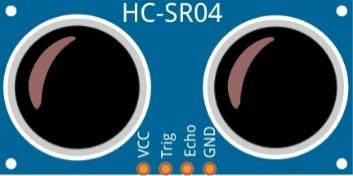
| Pin | Description |
|---|---|
| VCC | Power supply (5V) |
| Trig | Trigger pin — sends the pulse |
| Echo | Echo pin — outputs how long the pulse took to return |
| GND | Ground |
To take a reading: hold Trig HIGH for at least 10µs to fire a pulse. Echo then goes HIGH for as long as the sound is in flight, and goes LOW the instant the echo is received. Since sound travels at a constant ~340m/s, timing that HIGH duration gives the round-trip distance: distance = speed × time / 2 (divided by 2 because the sound travels to the object and back).
- Working voltage: 5V, working current: 12mA
- Measurable range: 2cm–200cm
Component List
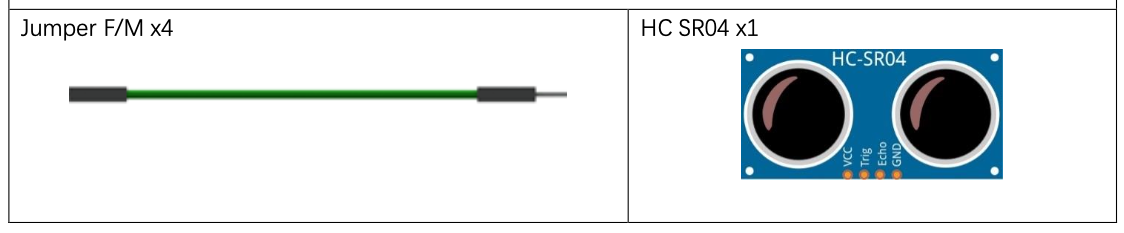
Circuit
The HC-SR04 runs on 5V, not 3.3V — make sure VCC is wired to the 5V rail.
Wiring Diagram
Disconnect all power before building the circuit. Reconnect once verified.
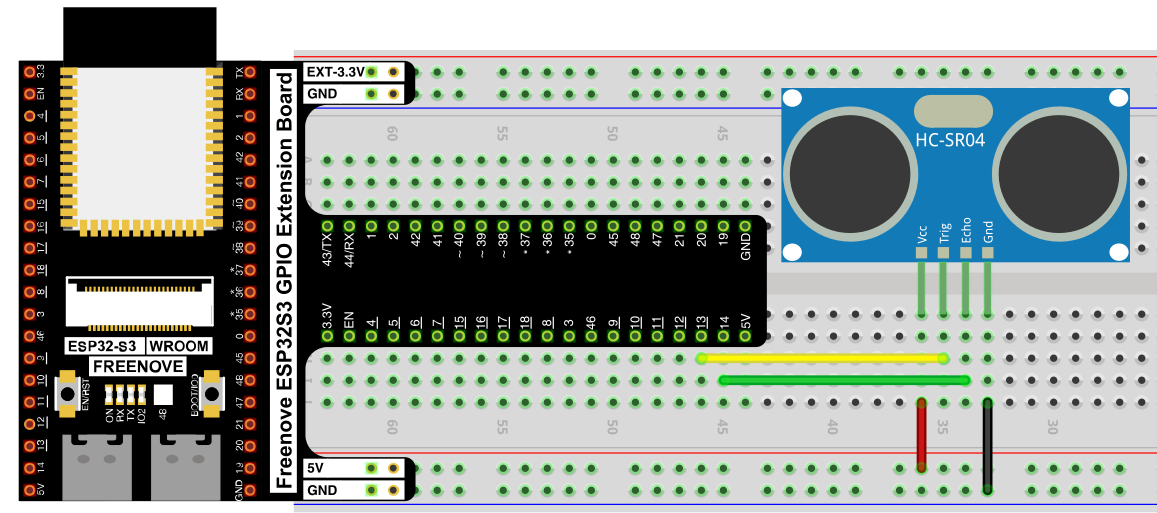
Connections:
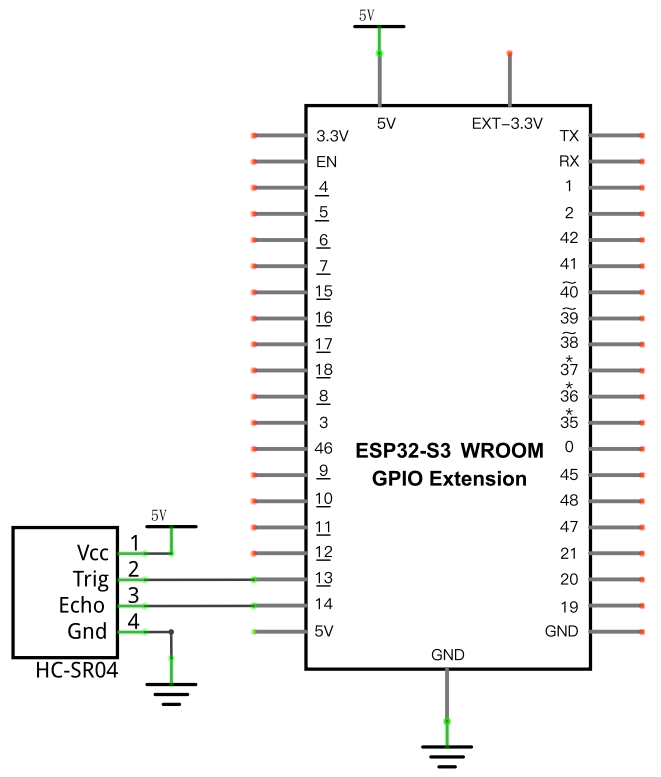
- HC-SR04 Vcc → 5V
- HC-SR04 Trig → GPIO13
- HC-SR04 Echo → GPIO14
- HC-SR04 Gnd → GND
Schematic Diagram
Code
File: 03_sensors/code/Ultrasonic_Ranging.py
from machine import Pin
import time

trigPin=Pin(13,Pin.OUT,0)
echoPin=Pin(14,Pin.IN,0)

soundVelocity=340
distance=0

def getSonar():
    trigPin.value(1)
    time.sleep_us(10)
    trigPin.value(0)
    while not echoPin.value():
        pass
    pingStart=time.ticks_us()
    while echoPin.value():
        pass
    pingStop=time.ticks_us()
    pingTime=time.ticks_diff(pingStop,pingStart)
    distance=pingTime*soundVelocity//2//10000
    return int(distance)

time.sleep_ms(2000)
while True:
    time.sleep_ms(500)
    print('Distance: ',getSonar(),'cm' )
How to Run
Online
- Open Thonny →
03_sensors/code/. - Double-click
Ultrasonic_Ranging.py. - Click Run current script. After a 2-second warm-up, the Shell prints the measured distance every 500ms — move an object closer or further away and watch it change.
Code Explanation
Fire a trigger pulse
trigPin.value(1)
time.sleep_us(10)
trigPin.value(0)
Holds Trig HIGH for 10 microseconds, telling the HC-SR04 to send an ultrasonic pulse.
Time the echo
while not echoPin.value():
    pass
pingStart=time.ticks_us()
while echoPin.value():
    pass
pingStop=time.ticks_us()
pingTime=time.ticks_diff(pingStop,pingStart)
Waits for Echo to go HIGH (the pulse has been sent), records the start time, then waits for it to go LOW again (the echo was received) and records the stop time. time.ticks_diff() safely computes the elapsed microseconds even if the internal tick counter has wrapped around.
Convert time to distance
distance=pingTime*soundVelocity//2//10000
soundVelocity is in m/s; dividing by 2 accounts for the round trip, and //10000 converts the units down to centimeters (since pingTime is in microseconds and velocity is in m/s).
Key Concepts
- Time-of-flight sensing: distance is calculated from how long a signal takes to travel there and back, not measured directly
time.ticks_us()/time.ticks_diff(): MicroPython’s safe way to measure short, precise time intervals (handles counter rollover, unlike subtracting raw values)- Busy-wait loops (
while not echoPin.value(): pass): block execution until a pin changes state — simple, but ties up the CPU while waiting
Further Exploration
- Add a check that returns an error/
NoneifgetSonar()waits too long (the object may be out of range). - Trigger an LED or buzzer when the distance falls below a threshold (e.g. a proximity alarm).
Adapted from Python_Tutorial.pdf Project 21.1