Introduction to Python and Microcontrollers
Motor & Driver: Control Motor with Potentiometer
Control both the speed and direction of a DC motor from a single potentiometer, using an L293D motor driver chip.
New Concepts
- DC Motor
- H-bridge motor drivers
- Bidirectional speed control from one analog input
DC Motor
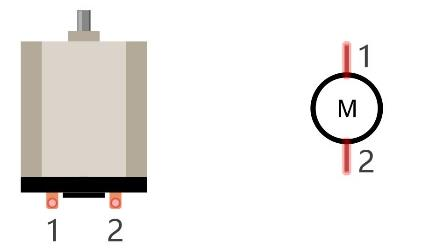
A small DC motor has two pins; connecting them to power spins it one way, and reversing the polarity spins it the other way.
L293D Motor driver
A relay can switch a motor on/off. The L293D is a 4-channel motor driver chip that can additionally control speed (via PWM) and direction (by swapping which output is HIGH and which is LOW) — without ever exposing the ESP32-S3 to the motor’s higher-power circuit.
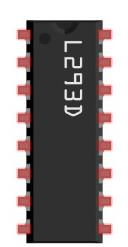
| Pin | Description |
|---|---|
| In x (2, 7, 10, 15) | Digital signal input for channel x |
| Out x (3, 6, 11, 14) | Output for channel x — mirrors its In pin’s level, connected to +Vmotor or 0V |
| Enable1 (1) | Enables channels 1 & 2 — HIGH to enable |
| Enable2 (9) | Enables channels 3 & 4 — HIGH to enable |
| 0V (4, 5, 12, 13) | Ground |
| +V (16) | Logic supply, 3.0–36V |
| +Vmotor (8) | Motor power supply, up to 36V |
Wiring a motor to channels 1 & 2: feeding opposite levels to In1/In2 sets the rotation direction, and a PWM signal on Enable1 controls the speed. (Channels 3 & 4 work the same way via In3/In4/Enable2.)
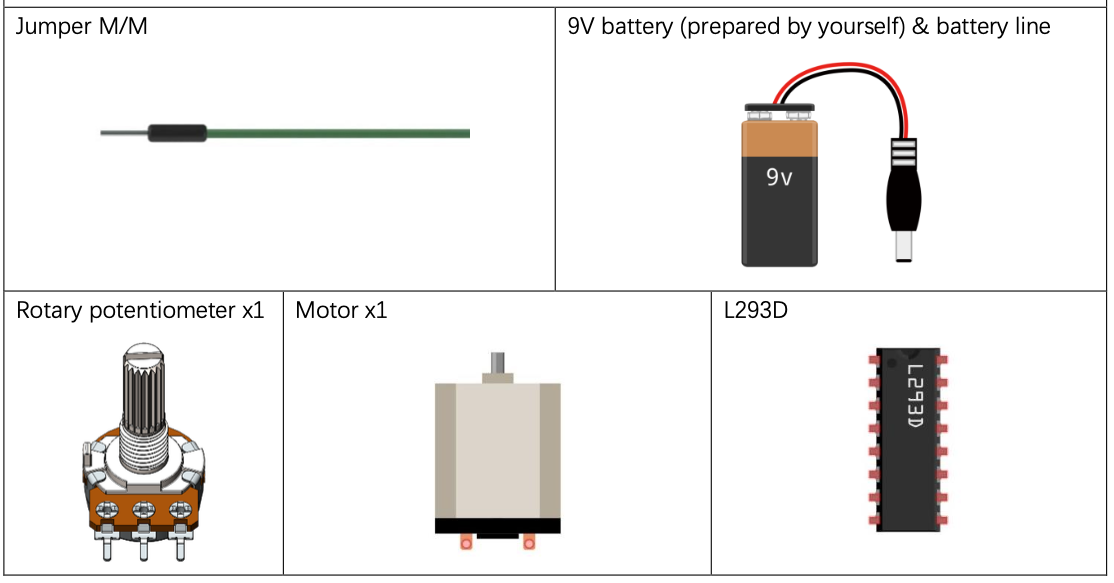
Component List
Circuit
Never power the motor directly from the ESP32-S3 — use a separate (or 9V battery) supply for the L293D’s
+Vmotor, sharing ground with the ESP32-S3.
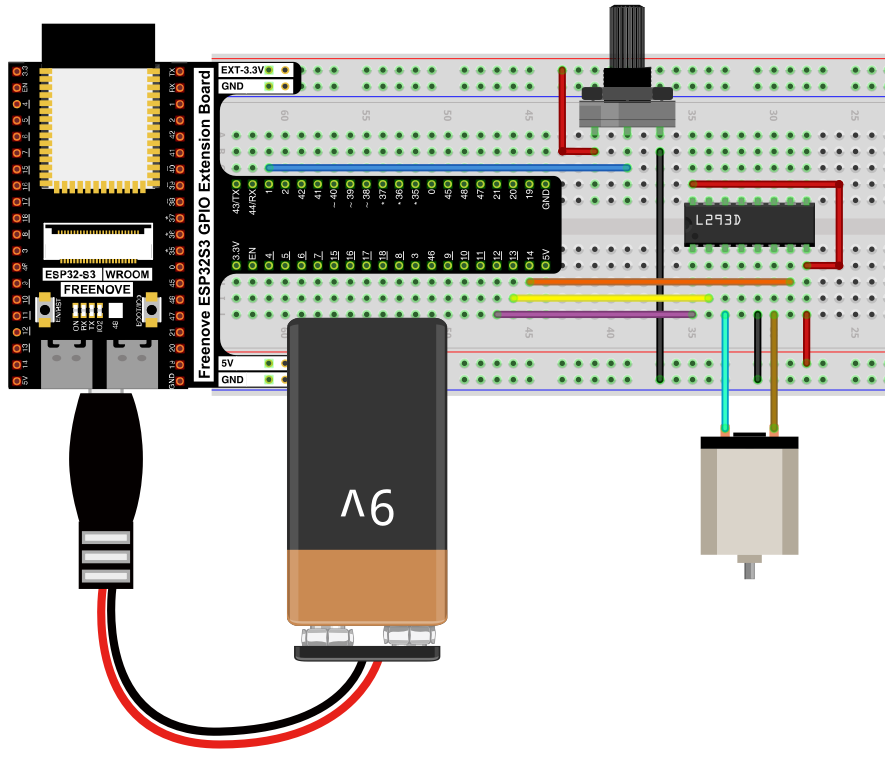
Wiring Diagram
Disconnect all power before building the circuit. Reconnect once verified.
Connections:
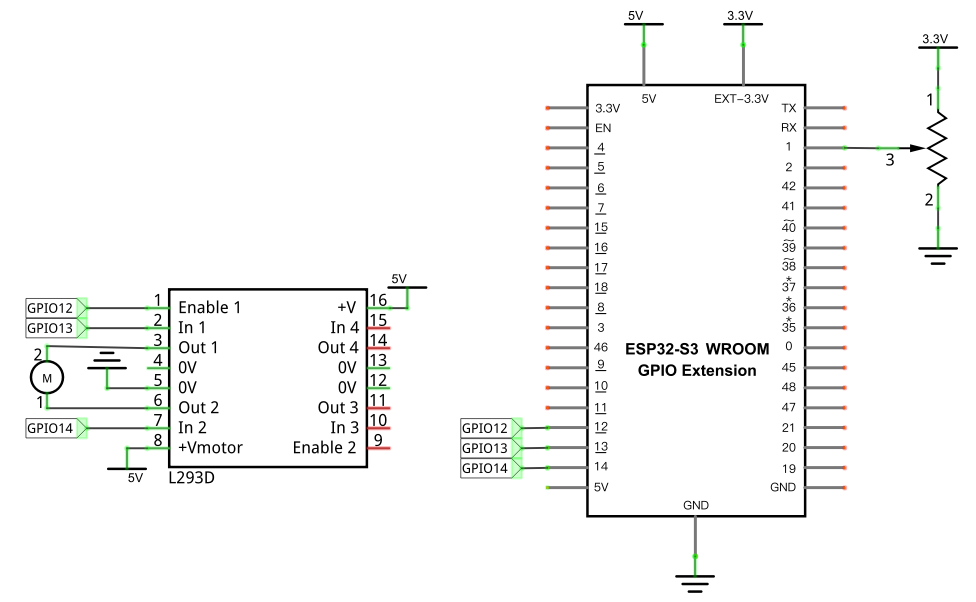
- L293D In1 → GPIO13, In2 → GPIO14, Enable1 → GPIO12 (PWM)
- L293D Out1/Out2 → motor
- Potentiometer wiper → GPIO1 (ADC)
Schematic Diagram
Code
File: 04_output/code/Motor_And_Driver.py
from machine import ADC,Pin,PWM
import time
import math

in1Pin=Pin(13, Pin.OUT)
in2Pin=Pin(14, Pin.OUT)

enablePin=Pin(12, Pin.OUT)
pwm=PWM(enablePin,10000)

adc=ADC(Pin(1))
adc.atten(ADC.ATTN_11DB)
adc.width(ADC.WIDTH_12BIT)

def driveMotor(dir,spd):
    if dir:
        in1Pin.value(1)
        in2Pin.value(0)
    else :
        in1Pin.value(0)
        in2Pin.value(1)
    pwm.duty(spd)

try:
    while True:
        potenVal = adc.read()
        rotationSpeed = potenVal - 2048
        if (potenVal > 2048):
            rotationDir = 1;
        else:
            rotationDir = 0;
        rotationSpeed=int(math.fabs((potenVal-2047)//2)-1)
        driveMotor(rotationDir,rotationSpeed)
        time.sleep_ms(10)
except:
    adc.deinit()
    pwm.deinit()
How to Run
Online
- Open Thonny →
04_output/code/. - Double-click
Motor_And_Driver.py. - Click Run current script. Turn the potentiometer one way and the motor speeds up in one direction; turn it the other way and it slows, stops, then speeds up in reverse.
Code Explanation
Set up direction pins, a PWM-enabled speed pin, and the ADC
in1Pin=Pin(13, Pin.OUT)
in2Pin=Pin(14, Pin.OUT)
enablePin=Pin(12, Pin.OUT)
pwm=PWM(enablePin,10000)
adc=ADC(Pin(1))
in1Pin/in2Pin set direction; PWM on enablePin sets speed; the ADC reads the potentiometer, exactly as in Read the Voltage of a Potentiometer.
Drive the motor at a given direction and speed
def driveMotor(dir,spd):
    if dir:
        in1Pin.value(1)
        in2Pin.value(0)
    else :
        in1Pin.value(0)
        in2Pin.value(1)
    pwm.duty(spd)
Setting In1/In2 to opposite levels picks the direction; the PWM duty cycle on Enable1 controls how fast it spins.
Map the potentiometer’s midpoint to “stopped”
potenVal = adc.read()
if (potenVal > 2048):
    rotationDir = 1
else:
    rotationDir = 0
rotationSpeed=int(math.fabs((potenVal-2047)//2)-1)
driveMotor(rotationDir,rotationSpeed)
The ADC’s range (0–4095) is split at its midpoint (2048): values above it mean one direction, values below mean the other. Subtracting 2047, taking the absolute value, and halving it converts “distance from center” into a speed — so the motor is stopped when the knob is centered and speeds up as it’s turned further toward either end.
Key Concepts
- H-bridge drivers: chips like the L293D let a motor be driven in either direction from low-power digital signals, isolating the motor’s higher-power circuit from the microcontroller
- Direction from digital pins, speed from PWM: a common motor-control pattern — toggle two pins to pick direction, vary one PWM duty cycle to pick speed
- Centering a control range: treating mid-scale as “neutral” and mapping distance-from-center to magnitude is a common pattern for bidirectional analog controls (similar logic appears in joysticks)
Further Exploration
- Add a small dead zone around the center (e.g. ±50) so the motor stays fully stopped near the middle instead of creeping at very low speed.
Adapted from Python_Tutorial.pdf Project 17.2