Introduction to Python and Microcontrollers
Resistors
Resistors are electronic components which have a specific, never-changing electrical resistance. The resistor’s resistance limits the flow of electrons through a circuit.
Commonly resistors are used to limit current, divide voltages, and pull-up I/O lines.
Resistor units
The electrical resistance of a resistor is measured in ohms. The symbol for an ohm is the greek capital-omega: Ω. The (somewhat roundabout) definition of 1Ω is the resistance between two points where 1 volt (1V) of applied potential energy will push 1 ampere (1A) of current.
Larger or smaller values of ohms can be matched with a prefix like kilo-, mega-, or giga-, to make large values easier to read. It’s very common to see resistors in the kilohm (kΩ). For example, a 4,700Ω resistor is equivalent to a 4.7kΩ resistor.
Schematic symbol
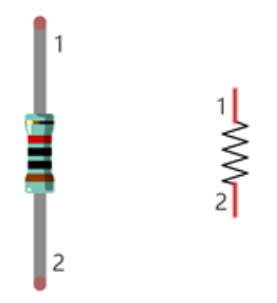
All resistors have two terminals, one connection on each end of the resistor. When modeled on a schematic, a resistor will show up as one of these two symbols:
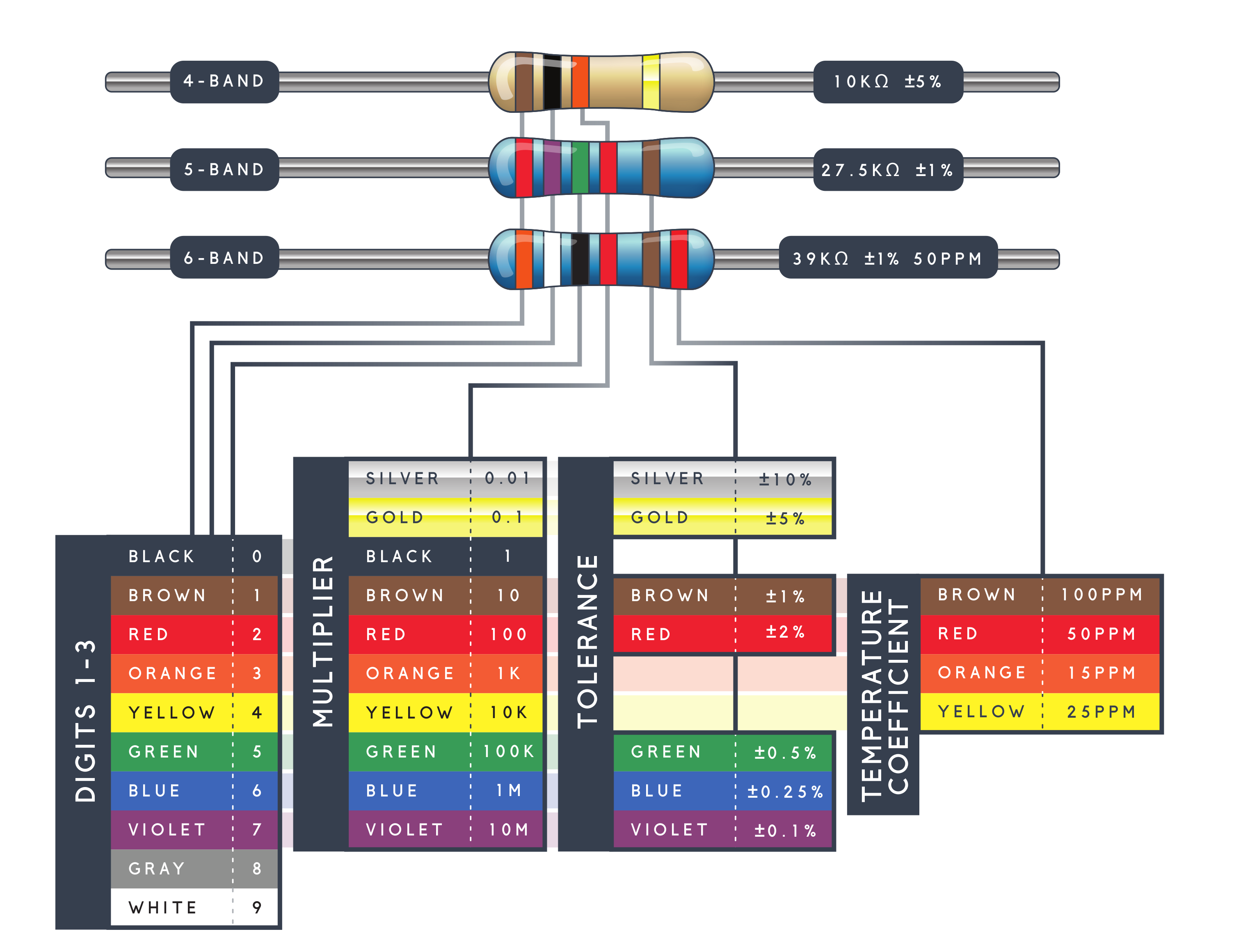
Color code table
Converts the colored bands on a resistor to a resistance value.
For further reading on resistors see this writeup on Sparkfun.com