Introduction to Python and Microcontrollers
Night Lamp
Make an LED automatically brighten in the dark and dim in bright light, using a photoresistor to sense ambient light — an automatic night lamp.
New Concepts
- Photoresistors (LDRs)
- Voltage dividers as a sensing technique
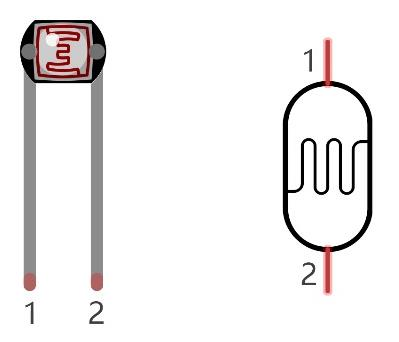
Photoresistor
A photoresistor (LDR) is a light-sensitive resistor — its resistance drops as more light hits its surface, and rises in the dark.
Voltage dividers
Pairing it with a fixed resistor in a voltage divider turns that resistance change into a voltage change, which the ADC can read.
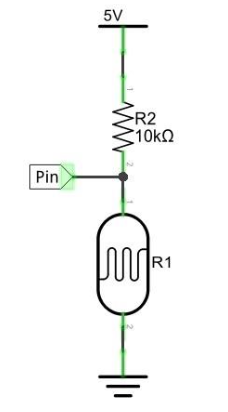
As ambient light changes, the photoresistor’s resistance changes, which shifts the voltage measured between it and the fixed resistor.
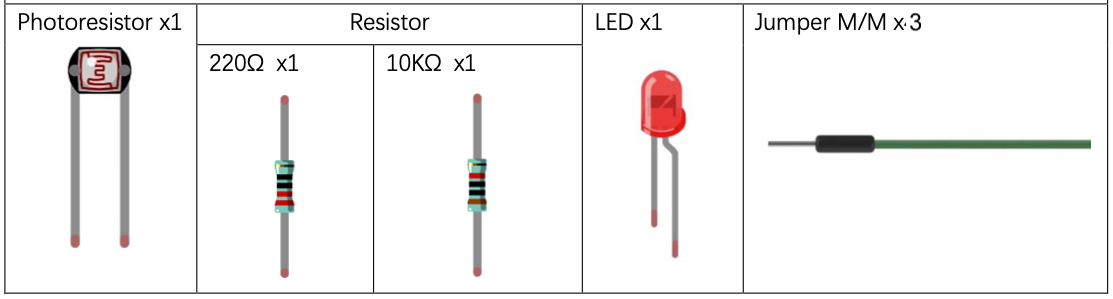
Component List
Circuit
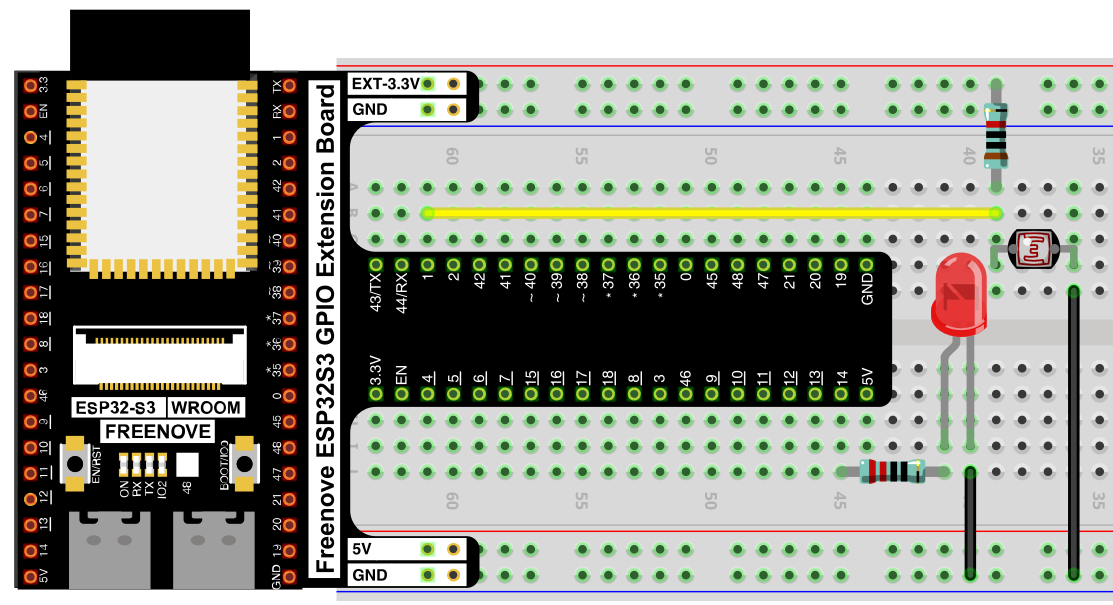
Wiring Diagram
Disconnect all power before building the circuit. Reconnect once verified.
Connections:
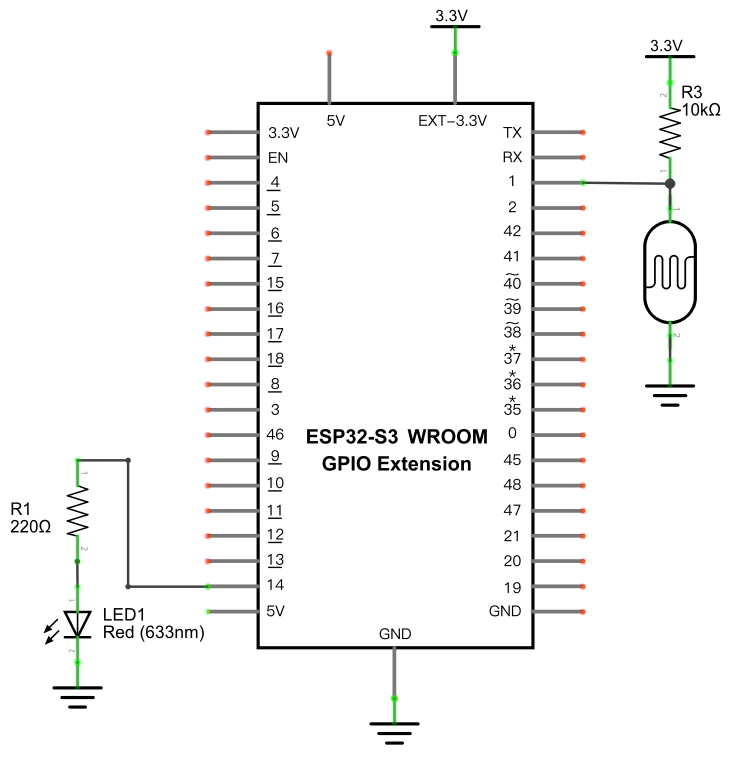
- 3.3V → 10kΩ resistor → GPIO1 → photoresistor → GND
- LED anode → 220Ω resistor → GPIO14
- LED cathode → GND
Schematic Diagram
Code
File: 03_sensors/code/NightLamp.py
from machine import Pin,PWM,ADC
import time

pwm =PWM(Pin(14,Pin.OUT),1000)
adc=ADC(Pin(1))
adc.atten(ADC.ATTN_11DB)
adc.width(ADC.WIDTH_12BIT)

def remap(value,oldMin,oldMax,newMin,newMax):
    return int((value)*(newMax-newMin)/(oldMax-oldMin))

try:
    while True:
        adcValue=adc.read()
        pwmValue=remap(adcValue,0,4095,0,1023)
        pwm.duty(pwmValue)
        print(adcValue,pwmValue)
        time.sleep_ms(100)
except:
    adc.deinit()
    pwm.deinit()
This is the exact same code as Soft Light — only the sensor wired to GPIO1 has changed.
How to Run
Online
- Open Thonny →
03_sensors/code/. - Double-click
NightLamp.py. - Click Run current script. Cover the photoresistor with your hand, or shine a light on it — the LED’s brightness changes in response.
Code Explanation
Since the circuit and code are logically identical to Soft Light, see Soft Light’s Code Explanation for a full walkthrough of remap() and the ADC → PWM pipeline. The only conceptual difference: the ADC value now reflects ambient light level instead of a knob’s position, and because the photoresistor’s resistance drops in bright light, more light produces a lower voltage on GPIO1 — which remaps to a lower PWM duty, dimming the LED in bright conditions and brightening it in the dark.
Key Concepts
- Photoresistor (LDR): a resistor whose resistance changes with light intensity
- Voltage divider sensing: pairing a variable resistor with a fixed one converts a resistance change into a readable voltage change
- Reusing code: the same ADC →
remap()→ PWM code from Soft Light works unchanged with a different sensor, because both produce a 0–4095 ADC reading
See Class ADC and Class PWM(pin, freq) for the full API reference.
Further Exploration
- Invert the brightness response (LED dims in the dark instead).
- Add a threshold so the LED only turns on below a certain light level, instead of dimming continuously.
Adapted from Python_Tutorial.pdf Project 11.1