Introduction to Python and Microcontrollers
Servo Sweep
Make a servo motor sweep continuously from 0° to 180° and back.
New Concepts
- Servo motors
- Driving a servo with PWM angle control
Servo
A servo packages a small DC motor, reduction gears, a position sensor, and control circuitry together, letting you command it to a specific angle (rather than just spinning continuously like the DC motor). Most hobby servos sweep a 180° range via their output “horn,” and can output far more torque than a bare DC motor of similar size.
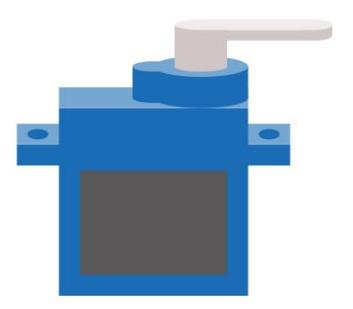
Controlling a servo with PWM signal
A servo has 3 wires: power (red, VCC), ground (brown, GND), and signal (orange). It’s positioned with a 50Hz PWM signal, where the pulse width (not the duty cycle percentage) determines the angle:
| Pulse width | Servo angle |
|---|---|
| 0.5ms | 0° |
| 1.0ms | 45° |
| 1.5ms | 90° |
| 2.0ms | 135° |
| 2.5ms | 180° |
Component List
Circuit
Servos need a clean 5V supply — double-check polarity before connecting power.
Wiring Diagram
Disconnect all power before building the circuit. Reconnect once verified.
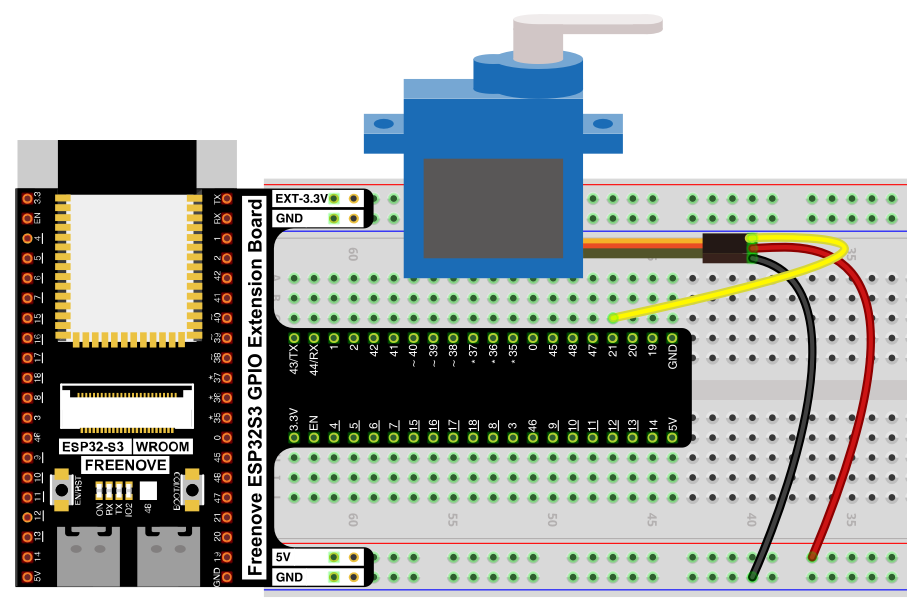
Connections:
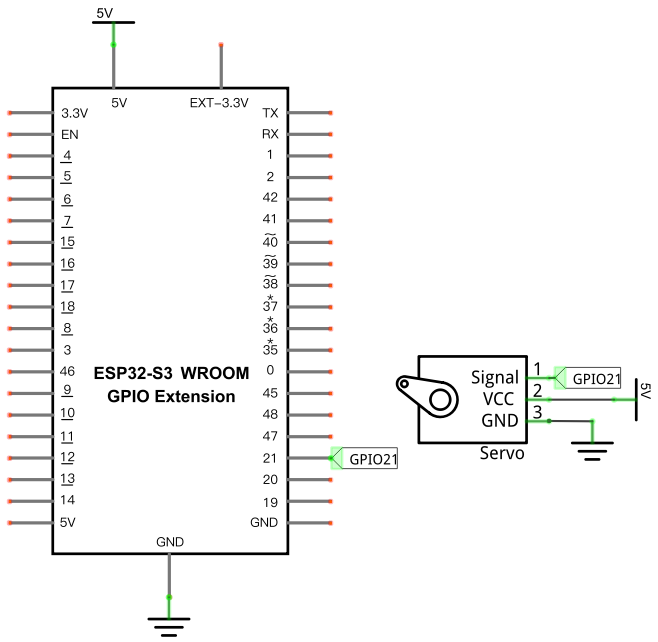
- Servo Signal → GPIO21
- Servo VCC → 5V
- Servo GND → GND
Schematic Diagram
Code
File: 04_output/code/Servo_Sweep.py
Module: 04_output/code/myservo.py
from myservo import myServo
import time

servo=myServo(21)#set servo pin
servo.myServoWriteAngle(0)#Set Servo Angle
time.sleep_ms(1000)

try:
    while True:
        for i in range(0,180,1):
            servo.myServoWriteAngle(i)
            time.sleep_ms(15)
        for i in range(180,0,-1):
            servo.myServoWriteAngle(i)
            time.sleep_ms(15)
except:
    servo.deinit()
How to Run
Online
- Open Thonny →
04_output/code/. - Right-click
myservo.py→ Upload to / — wait for it to finish uploading to the ESP32-S3. - Double-click
Servo_Sweep.py. - Click Run current script — the servo sweeps from 0° to 180° and back, repeatedly.
Code Explanation
Create the servo object and set a starting angle
servo=myServo(21)
servo.myServoWriteAngle(0)
time.sleep_ms(1000)
myServo(21) configures PWM on GPIO21 at the servo’s expected 50Hz. Setting it to 0° first and waiting a second gives the servo time to physically reach that position before the sweep starts.
Sweep up, then down
for i in range(0,180,1):
    servo.myServoWriteAngle(i)
    time.sleep_ms(15)
for i in range(180,0,-1):
    servo.myServoWriteAngle(i)
    time.sleep_ms(15)
Each loop steps the angle one degree at a time with a short pause, producing a smooth sweep rather than an instant jump (the same “ramp gradually” idea as Breathing LED’s PWM fade, just applied to angle instead of brightness).
Release the servo
except:
    servo.deinit()
Key Concepts
- PWM pulse width vs. duty cycle: most PWM uses described so far (LED brightness, motor speed) care about duty cycle percentage; servos instead care about the absolute pulse width in milliseconds, at a fixed 50Hz frequency
myServoWriteAngle(pos): converts a 0–180° angle into the correct underlying duty cycle, so application code never has to do that pulse-width math directly- Smooth motion via small steps: sweeping one degree at a time with a short delay, rather than jumping straight to the target angle, is the same incremental-change pattern used throughout this kit (breathing LEDs, gradient colors, motor speed ramps)
See class myServo for the full API reference.
Further Exploration
- Change the step size (e.g.
range(0,180,5)) for a faster, choppier sweep.
Adapted from Python_Tutorial.pdf Project 18.1